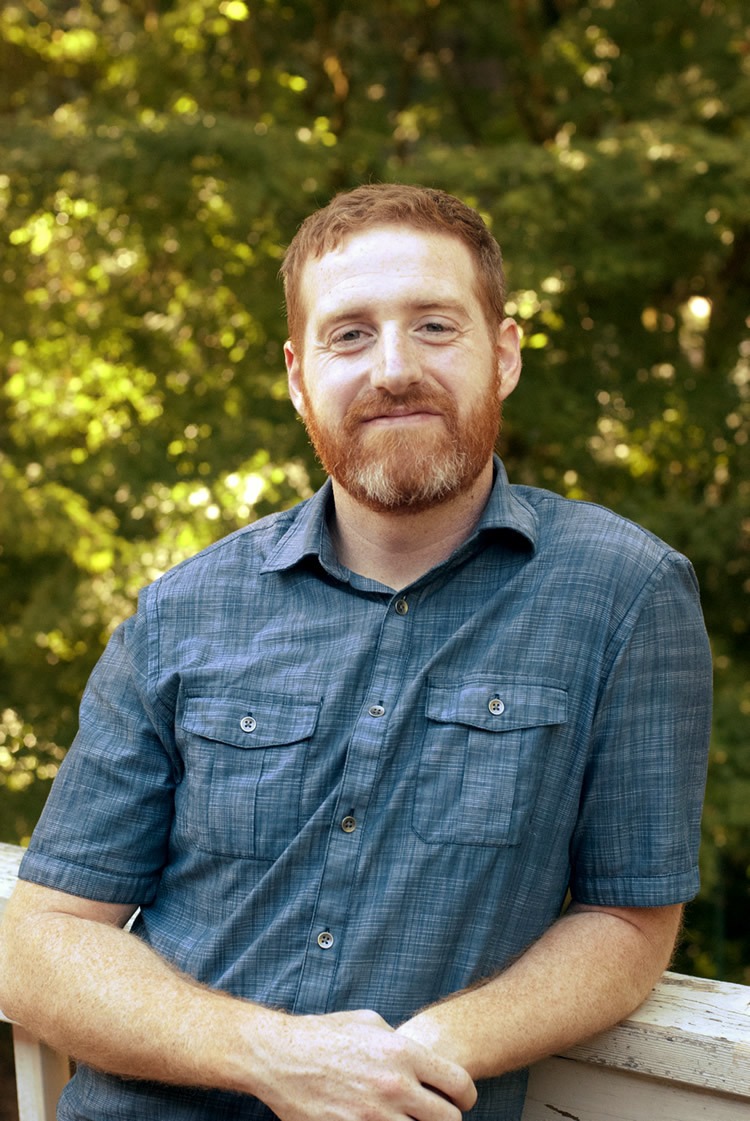
About Erik Johnston, LCPC
I love being
a therapist.
I hear people say they don't love what they do. I love being a therapist.
This doesn't mean it's all fun — it means I believe in it and it's an integral part of my life. It is not just a job and in this work you are not just another client.
School in Oregon.
A decade in the Pacific Northwest.
I completed my B.A. through a Great Books curriculum in Eugene, Oregon, then moved to Seattle for graduate school at Saybrook University's LIOS program — a program built around humanistic and depth psychology and understanding people in relationship. After graduating, I spent a decade split between Jumping Mouse Children's Center in Port Townsend, Washington, and private practice with adults and couples in Seattle. That's where I actually learned how people are formed and how they change — not in a classroom, but in the room with families, kids, individuals, and couples.
I work here in Kansas City now and see only in-person clients. I'm working plans for a children's center and an at-home practice when my home's ADU is finalized. Kansas City has been a unique city and I'm thankful for my west coast upbringing — it helps me better know and contrast KC life and the culture here.
Being well trained and experienced
is my job, not yours.
My primary experience is in relationships — whether that be partner to partner, parent to child, individual to peers, or family of origin. I began my work in mental health as a Job Coach and Counselor under private contract for the State of Oregon, completed my B.A. in the Liberal Arts through a Great Books curriculum in Eugene, Oregon, and moved to Seattle to attend Saybrook University's LIOS program — a program built around humanistic and depth psychology and understanding people in relationship.
I maintain active somatic trainings through ISMETA, PACT couples training, and Jungian trainings — including maintaining relationships within those communities as well as the ongoing study. What happens between two people is not just emotional — it's physical and relational and has its own logic. The same is true of what happens inside one person. My job is knowing which approaches serve your situation. Your job is showing up.
Schooling, education,
modalities, and theories.
Masters in Psychology with a Specialization in Therapy, Saybrook University LIOS program. Licensed Clinical Professional Counselor (LCPC) in Kansas. Primary influences: depth psychology, child and adult attachment theories, somatic therapies, Internal Family Systems, Bowenian and narrative approaches, Gestalt, dream work, sand tray, existential and humanistic frameworks.
I am dyslexic, which I think has made me a better therapist. I've always had to find my way into things from an uncommon angle and perspective, to understand structure by how it feels rather than how it's labeled. That's also the way I work in therapy — unique perspectives that include more of the whole person.
I still deeply value education. For this reason I naturally engage, train, and study in all forms of therapy, counseling, body work, spiritual work, and even technical behavioral trainings. I don't cut myself off from learning from anyone — for the sake of collecting what resources I can for whatever and whoever comes into my room. My job is to be open with what's out there and to narrow it down to what you need specifically — whether you are coming as an individual, a couple, or a family. Generally, general advice works only generally. Good therapy adapts to the people in the room.
Outside the office.
My needs and how I show up in the world are relevant and can be a distraction from your work — we are not working together for my sake and my needs are not the highest priority. That said, I prefer to be an open book and do not maintain a distant "analyst" perspective. No question is off limits about my personal life and I will answer if I believe it serves you and your work.
Still, some people ground better knowing a few personal details about the person they are working with. Here are a few that seem appropriate — do note that like with my education, I do not limit myself to male or female activities, specific cultural experiences, or economic limits. My goal is to be with people and engage in activities that help flourish my humanity regardless of the social rules or what "type" of person it makes me.
I enjoy being a body, mind, and spirit — my friends often refer to me as something of a renaissance man. I take up activities easily and often. They can be intuitive like dream work or Jungian fairy tale interpretation, or they can be more concrete — motorcycle work, AI and coding, book groups on emotional and relational health.
The activities that have probably stuck with me most, besides health and healing, are Muay Thai and FMA (Filipino Martial Arts), coding and computer work, stencil graffiti art, and cryptography.
My wife is a somatic and body therapist — she won the 2025 world championship in massage therapy. Our lives are dedicated to the support of ourselves, each other, and the people we serve, and our shared interests build on each other daily.
You can find me often with my wife playing music, dancing, cycling, and working out together. We are very different people, yet we manage to find each other more and more in our overlapping realities and in the home we've made together.
Now that I'm in KC, I've begun smoking meats and learning banjo — still new to both, and thankful for KC people being so willing to share their wisdom.